

Trial Reservoir Initiative de-risks water tech trials with repayable, performance-based funding and clear KPI, turning pilots into reliable implementations.
Vanessa van Rossum, Principal Consultant, Isle Northern Europe
In the water sector a failed investment doesn’t just burn capital: it undermines credibility with regulators, boards, and the public. Even when a technology is promising, internal resistance can stall progress.
At Isle, we’ve seen this pattern for more than a decade across utilities, industries, and regulators worldwide. Utilities are buried by data, reports and pilots, but technology adoption and implementation remains rare. This is precisely the gap the Trial Reservoir Initiative was created to close.
Why Trial Decisions Fail, Even Before They Begin
Most organizations lack a structured, trusted, cross-departmental process for deciding:
- Is this technology actually viable in our operations?
- Does it solve a real operational problem or just look impressive?
- How do we compare solutions fairly and transparently?
- How can we avoid unwanted long-term surprises with an ‘unproven’ technology?
Without a defensible method, every evaluation feels like a gamble. And in risk-averse environments, gambling rarely gets green lights.
When the decision pathway is unclear, every stakeholder protects themselves. Innovation teams hesitate because they lack operational proof; Operations teams resist because they’ve seen too many “promising” tools die in the field; Finance delays because the risk profile is too high; Management waits because they cannot justify the reputational exposure. Projects stall, not because the solutions are weak, but because the decision-making framework gives them no shared baseline to trust.
Utilities need a structured, transparent, defensible method that produces decisions everyone can stand behind: Operations, Innovation, Finance, Compliance, and Management.
Introducing the Trial Reservoir: De-risking Technology Demonstrations
Launched in 2021 by Isle and now an independent not-for-profit under the Tech Ascend Foundation, the Trial Reservoir Initiative exists for one purpose: to help utilities, industries, and communities adopt high-impact water technologies quickly, safely, and with evidence that stands up to scrutiny.
The Trial Reservoir focuses on technologies at TRL 7–9 that are ready for real-world demonstration but need proof in the end-user’s own operating environment. And here’s the key shift: If the technology doesn’t perform, the end-user pays nothing. This removes the single biggest barrier to adoption: financial and reputational risk.
The structure is simple, transparent, and performance-based:
- A repayable grant covers the cost of the trial: Funds flow to the technology vendor to help them install and demonstrate their solution at the end-user’s site.
- Key Performance Indicators (KPIs) and success criteria are co-developed: We work with both the user and the vendor to establish clear, operationally relevant metrics, not theoretical ones.
- If the trial succeeds, the user commits: This can be a hardware purchase, a multi-year subscription, or a lease, defined in advance.
- The vendor repays the funds into the Initiative: This replenishes the Reservoir and enables a next trial.
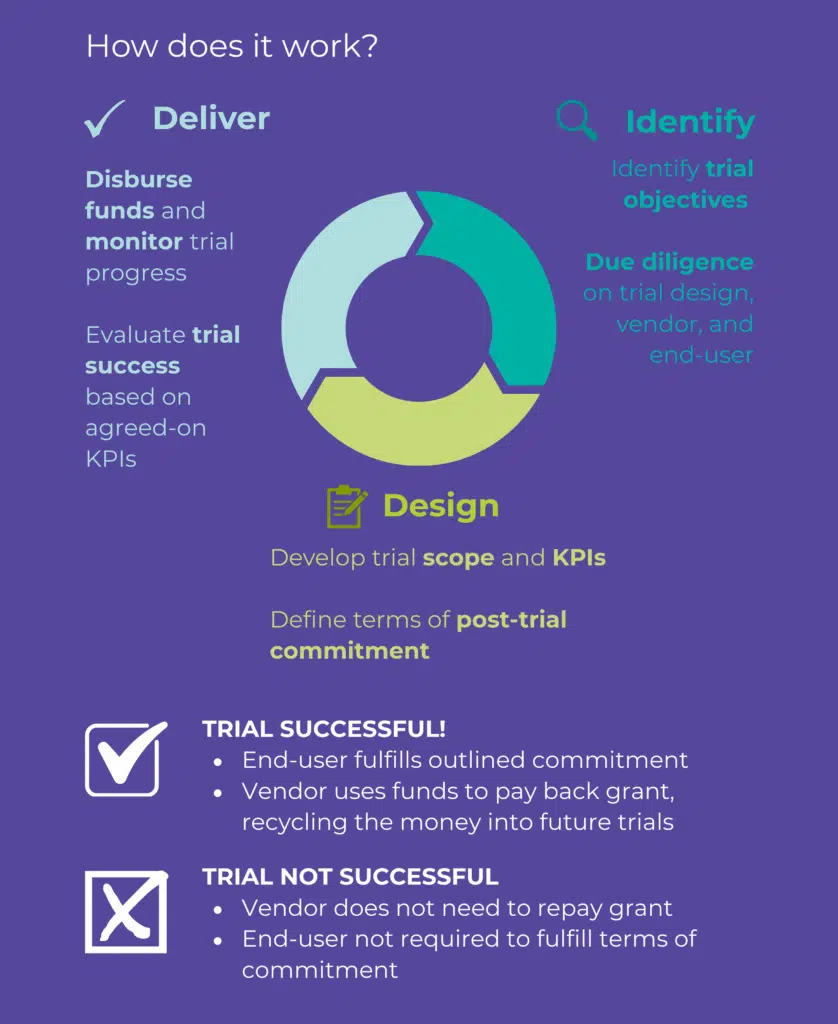
If the technology doesn’t meet the established KPIs, the vendor doesn´t have to repay the fund, nor does the end-use have to execute the purchase order agreed upon before pilot execution. This approach creates alignment across all stakeholders and keeps focus where it belongs: technology performance in real operations.
Before any trial starts, the Trial Reservoir Initiative ensures that there is a shared problem definition, transparent technical and operational KPIs, clear implementation pathways if the trial succeeds, and a timeline and governance model all stakeholders agree to. This avoids a trial’s common failure mode: “interesting trial, unclear next steps.”
Brabant Water uses Trial Reservoir Initiative pilot to drive utility innovation
Brabant Water’s trial with KenWave arose from a technology scan that Isle’s consulting arm conducted for them around alternative pipe condition assessment technologies.
With hundreds of kilometers of aging asbestos cement transmission mains, Brabant Water was particularly concerned about leaks and deterioration that might cause leaching into their drinking water. Because of the size of their service network, Brabant Water was also particularly concerned about maintaining service and flow through the pipes during assessment – something that isn’t always possible with traditional pipe assessment technologies like ultrasonic testing.
KenWave’s virboacoustic Dynamic Response Imaging™ (DRI™) technology allows for external inspection of the pipes, measuring residual pipe wall stiffness and interpreting this data to determine structural thickness. This non-invasive approach ensures minimal disruption for utilities using their technology. The KenWave trial took place over a 2-kilometer section of pipe that had already been baseline tested using ultrasonic technology. KenWave was able to confirm the technology’s reliability and accuracy, saving time and money for Brabant by reducing the number of access points and the amount of disruption during their testing process.

The Brabant Water/ Kenwave trial clearly shows how the Trial Reservoir model accelerates and de-risks the adoption of innovative technologies for utility clients. By funding the initial DRI trial through a repayable, performance-based structure, the program enabled Brabant Water to test a promising non-invasive condition assessment technology without upfront financial burden. This lowered barrier to entry allowed the utility to focus on operational needs, such as validating accuracy against prior ultrasonic testing benchmarks, while ensuring that repayment was tied only to successful outcomes.
This trial also highlights how co-developed KPIs translate into credible, actionable results. The trial met or exceeded all performance targets, demonstrating both reliability and scalability of the solution. Because the Trial Reservoir framework required clear performance metrics agreed by both the utility and the vendor, Brabant Water gained confidence in the technology’s real-world value, not theoretical promise.
Finally, the smooth transition from a successful trial to expanded deployment illustrates how the model creates a direct pathway from testing to implementation. With risk mitigated, costs covered upfront, and results validated, Brabant Water is now preparing to train internal teams and roll out DRI across additional pipeline segments, exactly the type of technology adoption the Trial Reservoir is designed to catalyze.
Why This Matters for the Water Sector
Communities aren’t waiting for another “proof of concept” and regulators aren’t waiting for perfect certainty. But decision-makers can’t take uncalculated risks. The Trial Reservoir Initiative bridges this gap by providing evidence strong enough to justify action, with risk low enough to make action safe. It turns innovation from a gamble into a structured process.
If you’re considering trialing a new technology, ask yourself one question: “Do we want another pilot, or a clear, defensible path to adoption?”
If the answer is the latter, the Trial Reservoir model is designed for you. Because information alone doesn’t create value. Implementation does.
To learn more about the Trial Reservoir Initiative, contact Jo Burgess.